


TP-Link Powerline Adapter Speed vs Actual Speed Explained
The speed shown on the box or product specification of a powerline adapter is the maximum powerline rate at the physical layer — not the actual throughput speed you will experience. For TP-Link powerline speeds, the actual conversion rate is typically 20–30% of the declared powerline rate, depending on your home's electrical wiring. Interference from household wiring is the main reason actual throughput falls short of the declared rate. This page covers both the maximum powerline rate (AV) and the maximum wireless link rate (AC).
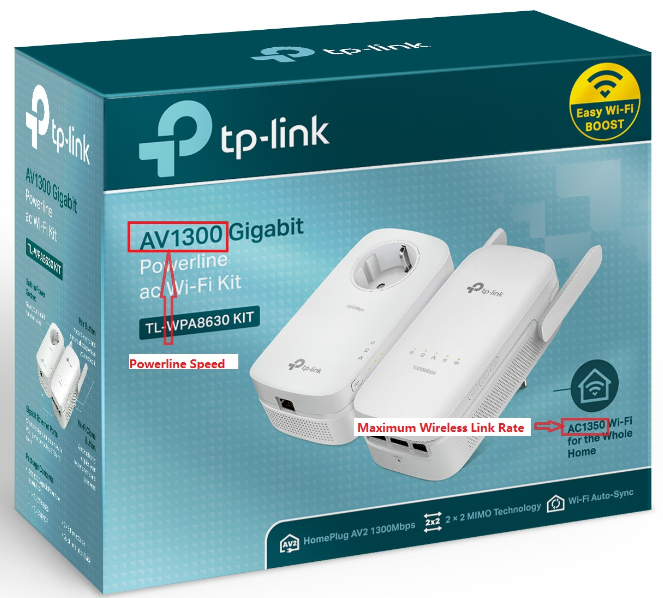
Let’s take TL-WPA8630KIT(TL-WPA8630 & TL-PA8010) as an example:
Key Takeaways
- The speed on the box (for example, AV1300) is the maximum powerline rate — not the actual data throughput.
- Actual throughput is typically 20–30% of the powerline rate, depending on your home's electrical wiring.
- For AV600 powerline adapters, throughput is capped at 100 Mbps due to the 10/100 Mbps Ethernet port limitation.
- HomePlug AV2 adapters using MIMO technology typically have a lower conversion rate than standard HomePlug AV adapters.
- The AC wireless link rate shown on the box (for example, AC1350) is the maximum wireless negotiation rate, not the actual throughput. See how fast powerline Ethernet is and whether your outlet type may be affecting performance.
AV1300: What Is the Maximum Powerline Rate?
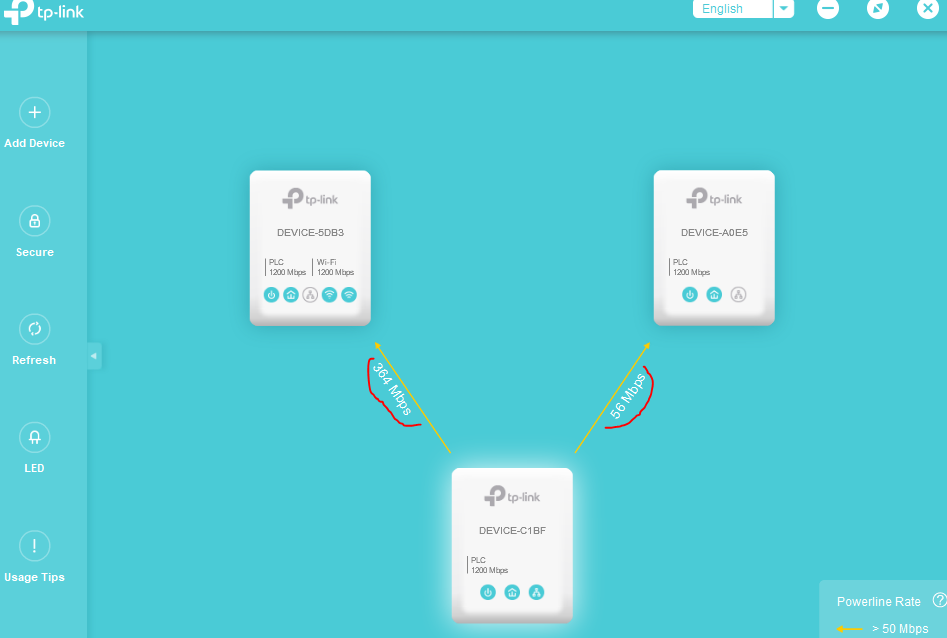
AV1300 is not the actual speed but the maximum powerline rate, as shown in the tpPLC utility. The powerline speed shown in the tpPLC utility will not reach 1300 Mbps due to interference in the powerline environment.
We ran two tests under the interference conditions below. The Powerline speed between the TL-WPA8630 and two TL-PA8010s was only up to 364 Mbps and 56 Mbps. However, the conversion rate (the ratio of the transmission rate to the powerline rate) is about 20%–30% (the actual conversion rate depends on the electrical wiring system). So the actual throughput should be about 73Mbps-109Mbps.
Let’s assume the Powerline speed between the TL-WPA8630 and TL-PA8010 is 1000Mbps in an ideal environment with little interference; normally, it will make an actual throughput of 300Mbps-350Mbps. This rule basically applies to all HomePlug AV products.
Notes:
1. AV600(TL-WPA4010KIT) powerline adapters have a powerline rate of 500 Mbps in an ideal environment, and they should have a throughput of about 150Mbps-175Mbps theoretically, but their throughput should not spike more than 100 Mbps, since they only have an Ethernet port of 10/100 Mbps. Therefore, if the AV600 powerline adapters' powerline rate exceeds 200 Mbps, customers can expect about 100 Mbps with our AV600 powerline adapters.
2. Some Powerline adapters work with the Homeplug AV standard; however, Homeplug AV2 powerline adapters, which use MIMO technology, have a lower conversion rate. For example, if the powerline rates on the Utility could reach 400 M, then according to the conversion rate we mentioned, the throughput of the HomeplugAV powerline adapters would be around 120Mbps-140Mbps. But HomePlug AV2 powerline adapters that use MIMO technology would have a lower conversion rate.
AC1350: What Is the Maximum Wireless Link Rate?
The AC1350 rate on the box is the maximum wireless link rate your client can use to communicate with the router, also called the wireless negotiation rate, which is the physical rate specified in IEEE Standard 802.11. It will vary due to many factors. Please refer to the explanation of the speed parameters on the TP-Link product box for more details.
If you have more questions, except for the speed, please refer to the most frequently asked questions about TP-Link powerline devices.
Looking For More
¿Es útil esta pregunta frecuente?
Sus comentarios nos ayudan a mejorar este sitio.



TP-Link Community
Still need help? Search for answers, ask questions, and get help from TP-Link experts and other users around the world.