


Hardware vs. Software Firewall: What's the Difference?
Every business network needs a firewall: a security system that monitors and controls traffic, allowing approved connections while blocking unauthorized or suspicious activity. One of the most common questions is whether a firewall should be deployed as dedicated hardware or delivered through software — and which approach best fits your environment.
Hardware firewalls are physical appliances installed at the network edge or between segments to inspect and control traffic. Software firewalls deliver the same network-level protection through software running on virtualized platforms, integrated gateway/router infrastructure, or cloud instances — rather than a dedicated physical box.
Both help protect against unauthorized access, but they differ in deployment model, scalability, performance, and management requirements.
For many businesses, the best choice is not simply hardware vs. software, but understanding where each approach fits and when a combination of both makes sense.
A quick note on scope: this article focuses on network-level firewalls that protect networks, sites, or segments. Host-based (personal) firewalls — software such as the built-in firewall on a single PC or server that protects only that one device — are a related but separate category and are outside the scope of this comparison.
Hardware vs. Software Firewall: At a Glance
This comparison is often framed as a physical firewall vs. virtual or software-based firewall. Hardware firewalls use dedicated appliances, while software firewalls deliver similar network security functions through software deployed on servers, virtual environments, or cloud infrastructure.
The table below outlines the key differences between hardware and software firewalls, with each covered in more detail below.
| Hardware Firewall | Software Firewall | |
| Deployed on | Dedicated physical appliance | Standard server hardware, virtual machine, or cloud platform |
| Protects | Networks, sites, or segments | Networks, cloud environments, or virtual segments |
| Traffic scope | Traffic entering, leaving, or moving between network segments | Traffic routed through the software firewall instance |
| Management | Appliance-based or centralized controller | Centralized software console or cloud management |
| Cost | Higher upfront hardware investment | Lower hardware cost, often subscription or license-based |
| Best for | Offices, branch sites, on-prem networks | Cloud, hybrid environments, virtualized infrastructure |

What Is a Hardware Firewall?
A hardware firewall is a dedicated physical appliance that inspects and controls traffic moving between networks or network segments. It is commonly deployed at the network edge, where traffic entering or leaving the business environment passes through it, but it can also be used internally to separate VLANs or sensitive systems.
The firewall applies security rules to allow approved traffic, block unauthorized connections, and help reduce exposure before traffic reaches internal resources.
Because it runs on purpose-built hardware, a hardware firewall uses dedicated processing resources for inspection and security services. In business environments, hardware firewalls are often integrated into gateway devices that also handle WAN connectivity, routing, and VPN services. On smaller gateway-class appliances, firewall, routing, and VPN functions may share the same general-purpose CPU, so real-world throughput depends on how much processing capacity the appliance provides.
Pros
-
Network-wide protection from a single point. A hardware firewall can enforce security policies across the network without requiring separate firewall instances for each environment.
-
Dedicated processing resources. Traffic inspection runs on purpose-built hardware, helping maintain performance without competing for shared server or virtualization resources.
-
Centralized policy management. Security rules are configured and enforced in one place, making it easier to maintain consistent policies across the network.
-
Independent security layer. Because it operates as a separate appliance, a hardware firewall remains isolated from the workloads and systems it protects.
Cons
-
Higher upfront cost. Dedicated hardware typically requires a larger initial investment than software-based firewall licensing or virtual deployments.
-
Less deployment flexibility. A hardware firewall is tied to a physical appliance, which can make rapid scaling, migration, or temporary deployments less flexible than software-based options.
-
Physical footprint. Hardware firewalls require installation space, power, and on-site deployment, which may be less practical for very small offices, remote sites, or fully cloud-based environments.
Best for
Hardware firewalls are well-suited to business networks that need reliable, centralized security at a physical site or branch location. They are especially effective in offices, retail locations, campuses, and multi-site environments where consistent policies must be enforced across users, devices, and network segments.
They are also a strong fit for environments that require VLAN segmentation between guest, employee, POS, voice, or IoT networks, as well as organizations that prefer dedicated on-site infrastructure for routing, VPN, and security services.
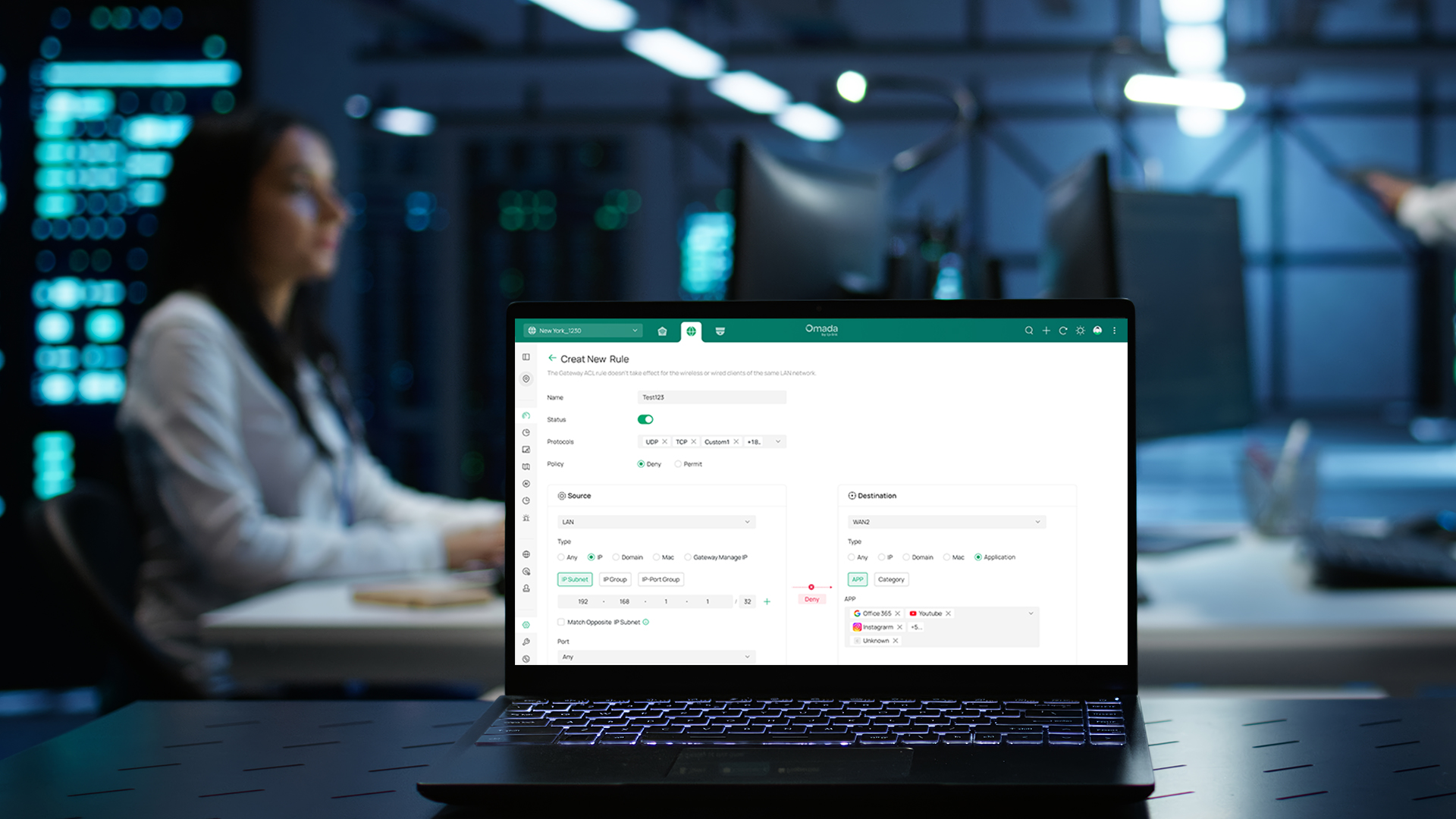
What Is a Software Firewall?
A software firewall delivers firewall functions through software rather than a dedicated physical appliance. It inspects and controls traffic between networks or network segments, using the same core security principles as a hardware firewall but with a different deployment model.
Software firewalls are commonly deployed on standard servers, virtual machines, cloud infrastructure, or integrated gateway platforms. This makes them a flexible option for organizations that need firewall protection in virtualized, hybrid, or rapidly changing environments. Note that a firewall built into a dedicated gateway or router is considered a hardware firewall, since it runs on hardware dedicated to that role.
Depending on the platform, software firewalls can provide features such as traffic filtering, VPN support, intrusion prevention, application control, and centralized policy management.
Pros
-
Flexible deployment. A software firewall can be deployed as a virtual appliance on existing network infrastructure, on cloud platforms, or on standard server/VM hosts — without requiring a dedicated physical appliance.
-
Lower upfront hardware costs. Because it runs on existing or virtualized infrastructure, software firewalls often reduce the initial capital investment associated with dedicated hardware.
-
Scalable capacity. Many software firewalls can scale by allocating additional resources or deploying new instances as network demands grow.
-
Well-suited to cloud and hybrid environments. Software firewalls are a strong fit for organizations securing virtualized workloads, remote sites, or infrastructure spread across on-premise and cloud environments.
Cons
-
Depends on underlying resources. Performance is tied to the CPU, memory, and platform resources allocated to the firewall instance. Poor sizing can limit throughput or advanced security features.
-
Greater deployment complexity in some environments. Software firewalls may require virtualization, cloud, or server administration expertise in addition to firewall configuration.
-
Ongoing licensing costs. Many software firewall solutions use subscription or usage-based pricing, which can increase over time as environments expand.
-
Shared infrastructure risk. Because the firewall runs on underlying infrastructure, outages or resource contention on the host platform can affect firewall availability.
Best for
Software firewalls are well-suited to cloud, hybrid, and virtualized environments where flexibility and rapid deployment are priorities. They are a strong fit for organizations securing workloads across public cloud platforms, private infrastructure, remote sites, or mixed on-premise and cloud networks.
They are also a practical choice for businesses that want to scale firewall capacity more quickly, deploy protection without dedicated hardware at every location, or manage distributed environments through centralized software controls.
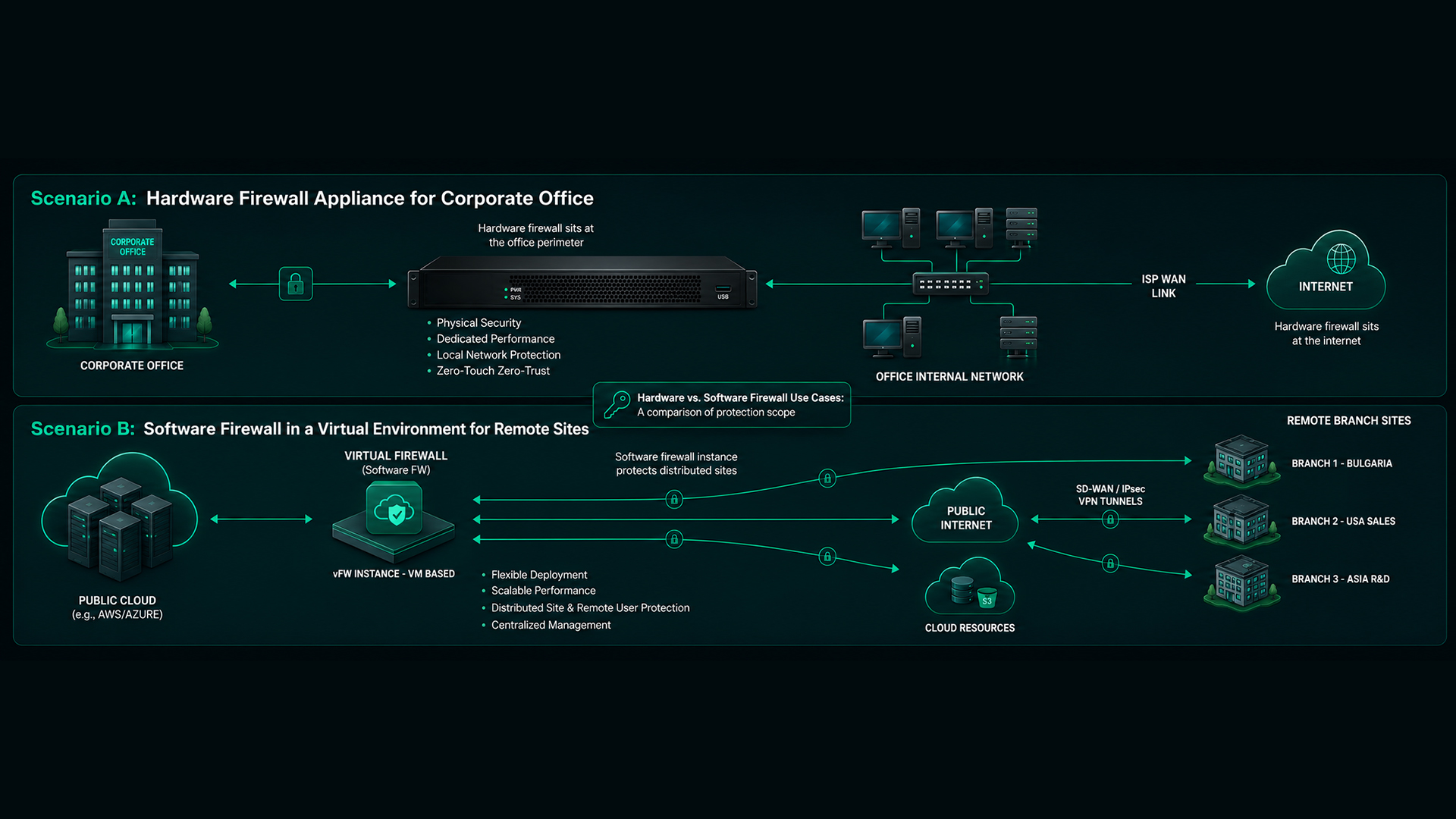
Hardware vs. Software Firewall: A Detailed Comparison
Choosing between hardware and software firewalls depends on your infrastructure, performance requirements, deployment model, and how you prefer to manage security. Below is a closer look at how the two approaches compare for business networks.
Scope
A hardware firewall is typically deployed as a centralized physical appliance protecting a site, branch, or network segment from a single enforcement point. Devices and traffic routed through it inherit the same security policies.
A software firewall can provide similar network protection, but through software deployed on servers, virtual machines, or cloud infrastructure. It is often used to secure virtual environments, cloud workloads, remote locations, or specific network segments without requiring dedicated hardware.
For many businesses, the difference is less about coverage and more about where the firewall is deployed and how the environment is built.
Configuration
Hardware firewalls are typically configured through a web interface, command line, or centralized controller. Policies can be applied across sites, VLANs, IP ranges, users, or traffic types from a single management point.
Software firewalls are configured through software consoles, virtual management platforms, or cloud dashboards. They often support centralized policy deployment across multiple firewall instances, making it easier to manage security consistently across distributed, hybrid, or remote environments.
Cost
Hardware firewalls often involve a higher upfront investment because they require dedicated appliances. For many businesses, that cost is balanced by centralized protection, predictable performance, and long hardware lifecycles.
Software firewalls may offer a lower initial hardware barrier, especially when deployed on existing infrastructure or in the cloud. However, costs are often tied to subscriptions, throughput tiers, user counts, or resource consumption, which can increase as environments grow.
Flexibility
Software firewalls generally offer greater deployment flexibility. They can be installed on standard hardware, deployed as virtual appliances, or launched in cloud environments, making them easier to adapt as infrastructure changes.
They are often well-suited to organizations that need to add locations quickly, secure temporary environments, or extend protection across hybrid networks without shipping new hardware.
Hardware firewalls provide consistent, centralized enforcement, but because they rely on physical appliances, expansion or relocation can require additional hardware purchases, installation, or replacement cycles.
Installation
A hardware firewall is installed as a physical appliance, typically at the network edge alongside a router or integrated into a gateway device. Deployment may involve cabling, placement, and coordination with existing network infrastructure.
A software firewall is installed as software on supported server hardware, virtual machines, or cloud platforms. Because it does not require a dedicated appliance, deployment can often be faster in virtualized or distributed environments.
Deployment
Hardware firewalls are commonly used in on-premise business environments, branch offices, retail locations, and multi-site networks where dedicated on-site infrastructure is preferred.
Software firewalls are widely used in cloud, hybrid, and remote environments where deploying a physical appliance may be impractical or unnecessary. They are also a strong fit for distributed organizations that need consistent security across multiple locations or platforms.
Performance
Because a hardware firewall uses dedicated processing resources, it can inspect traffic without competing with other workloads for CPU or memory. This makes hardware appliances a well-suited option for environments with consistent throughput or demanding security requirements.
A software firewall relies on the resources of the server, virtual platform, or cloud environment where it is deployed. Performance can be excellent when properly sized, but throughput and advanced inspection features depend on the resources allocated to the firewall instance.
Requirements
A hardware firewall requires a physical appliance, power, network connectivity, and an appropriate place within the network design. It also requires ongoing configuration, updates, and maintenance.
A software firewall requires compatible server hardware, virtualization infrastructure, or cloud resources, depending on how it is deployed. It also depends on ongoing software administration.
Blocking
A hardware firewall is commonly positioned at the network edge or between internal segments, where it can block unauthorized traffic before it reaches protected systems. This makes it highly effective for controlling north-south traffic such as internet-bound or inbound connections.
A software firewall can apply similar controls within virtualized, cloud, or distributed environments, including traffic moving between workloads, sites, or network segments. This can help limit lateral movement and extend protection beyond a single physical perimeter.
Many organizations use both approaches together, combining dedicated on-site enforcement with flexible software-based protection across hybrid environments.
FAQs
What is the main difference between a hardware firewall and a software firewall?
The main difference is the deployment model. A hardware firewall is a dedicated physical appliance installed at the network edge or between segments, while a software firewall delivers similar security functions through software running on servers, virtual machines, cloud platforms, or integrated gateway infrastructure.
Both can inspect traffic, enforce security policies, and protect business networks, but they differ in flexibility, scalability, performance, and infrastructure requirements.
Which is better: hardware or software firewall?
Neither is universally better, because each is suited to different environments and operational needs. Hardware firewalls are often the stronger choice for on-premise sites, branch offices, and networks that benefit from dedicated performance and centralized on-site control. Software firewalls are often the better fit for cloud, hybrid, and remote environments where flexibility, rapid deployment, and scalable capacity are priorities.
Do I need both a hardware and software firewall?
In many business environments, yes. A hardware firewall can provide strong on-site protection at offices, branches, or other physical locations, while a software firewall can extend similar controls across cloud platforms, virtual infrastructure, or distributed networks. Using both together can create more consistent security across hybrid environments, especially for organizations operating across multiple sites or a mix of on-premise and cloud systems.
Are hardware firewalls more secure than software firewalls?
Not necessarily. Hardware firewalls can offer security advantages because they run on dedicated appliances, separate from general-purpose systems and shared workloads. Software firewalls can also be highly secure when properly deployed and maintained. In most cases, overall security depends more on configuration, patching, monitoring, and fit for the environment than whether the firewall is hardware or software.
Is a software firewall enough for a small business?
It can be, depending on how the business operates. For a cloud-based or distributed small business, a software firewall may provide the flexibility and protection needed without dedicated hardware. For a business with a physical office, shared network, or on-site systems, a hardware firewall is often the more practical foundation. Many small businesses use a mix of both as their needs grow.